Ramgram Stupa has drawn public attention after the Lumbini Development Trust (LDT) granted permission to two private companies to unearth the historical area and construct stupas, Vihars and other structures.
The Trust has agreed to lease out a total of 120 bigha (81.27 hectares) of land for 99 years to the Singapore-based Moksha Foundation and Nepal-based Promised Land. Of the total 120 bigha, 116 bigha (78.56 hectares) belongs to local residents and needs to be acquisitioned.
Recently, the vice-chairman of the Lumbini Development Trust, Lharkyal Lama, unilaterally decided to lease out the Ramgram area to the private companies ignoring written objections by the Ministry of Culture, Tourism and Civil Aviation, the Ministry of Finance and the Department of Archeology.
Against this backdrop, archaeologists have highlighted the significance of the Ramgram Stupa in Buddhism.
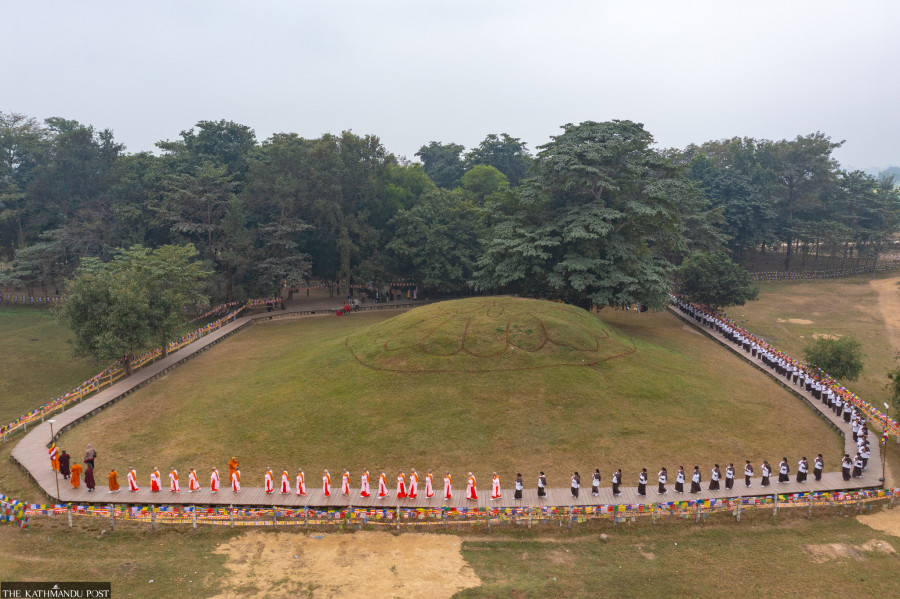
Ramgram Stupa is one of the eight original relic stupas where the corporeal remains of Gautam Buddha were enshrined. The stupa is a 7-metre high brick mound situated in ward 7 of Ramgram Municipality, around seven kilometres south of Parasi, the district headquarters of Nawalparasi West.
Some historians and archaeologists believe the ruins and artefacts date back to the Maurya era. Relics recovered during excavations in Ramgram and its surroundings suggest the area could have been the capital of the ancient Koliya state, the parental home of Buddha’s mother Mayadevi.
Lumbini in Rupandehi district is the birthplace of Siddhartha Gautam. He spent his princely life in Tilaurakot palace of Kapilvastu district while Ramgram Stupa is the revered relic stupa for Buddhists. This historic stupa lies on the bank of the Jharahi stream in the village of Ujjaini.
According to archaeologists and historians, Ramgram is the only stupa among the eight relic stupas to be left untouched to respect its sanctity.
Gautam Buddha, the Light of Asia, died in Kushinagar, India, at the age of 80. Kushinagar was then called Kushawati, the capital of Malla, which was one of the 16 Janapadas of the 6th century BCE.
According to Buddhist literature, seven rulers reached Kushinagar to bring the Asthidhatu (corporeal remains) of Lord Buddha. The Malla residents initially refused to give the remains, but they finally agreed to distribute the corporeal remains as per the suggestion of priest Drona. One of the Asthidhatus was brought and enshrined in Ramgram Stupa.